Why Does Turnitin Flag Writing I Typed Myself? Common Triggers
When I first saw Turnitin’s new AI-writing indicator flag my own original essay as “likely AI-generated”, I was floored. I had written every single word myself, citing sources, building a pro-con argument, and even giving examples from my own experience. I was surprised. But there it was: chunks of my writing, marked in a way that implied I might be guilty of something.
If you’ve ever opened a Turnitin report and wondered why your own writing has been flagged, even though you typed it yourself, you’re not alone. Students, instructors, and even academic technologists have run into similar surprises – and the answer to why it happens is not in human intent, but rather how the detection works and what it actually reflects.
In this article, I’ll discuss why Turnitin sometimes alerts on perfectly good human work, what “false positives” really mean, common patterns that lead to these alerts, and how you can, as a student or academic, interpret the data.
For a deeper understanding of how Turnitin’s AI writing detection works, including what it can and can’t reliably indicate, see our pillar article Does Turnitin Detect AI in 2026? What It Flags, Why It Flags, and Limitations.
1. Turnitin’s AI Indicator Is Not a Human Judge , It’s a Pattern Model
Turnitin’s AI detection tool doesn’t determine whether you used ChatGPT or other tools of any kind. It doesn’t read logs or compare text to a database of generated text. It looks at patterns in the language and style and calculates whether it matches what it sees in the patterns of AI text.
So when Turnitin flags something in your paper, it’s not accusing you of cheating, it’s highlighting text that statistically resembles the style of writing that the tool has seen in AI output.
It’s a probabilistic model, not a judgment of your character. Turnitin says that instructors should use professional judgment and interpret AI indicators in the context of the assignment and the student, and that the tool is there to inform, not to decide.
2. False Positives: When "Human" Writing Looks “AI”
A false positive occurs when the detector mistakenly reports that text is AI-generated. Turnitin has been upfront about the fact that while they try to limit false positives, they do happen , especially in certain ranges.
Turnitin explains that false positives — incorrectly identifying human writing as AI — do occur and must be interpreted with context.
This doesn’t imply dishonesty; it reflects the limitations of AI detection:
● Formal academic tone and structure:very clear, consistent sentences can resemble machine style.
● Highly polished or edited text: heavy revision for clarity can accidentally produce patterns the model finds similar to AI output.
● Technical vocabulary or repeated terminology — repeating discipline-specific terms may look formulaic.
Ironically, sometimes the better written your essay is — especially if it’s very organized, formal, and consistent in tone — the more likely it might resemble patterns common in AI writing.
In fact, Turnitin displays an asterisk (*) instead of a score for AI detection between about 1% and 19% because that range tends to have higher unreliability and false positives.
Turnitin shows an asterisk for low-confidence AI detection results (0–19%), signaling higher false positive likelihood.
3. What Real Students Experience , Not Just Theory
There are worse real life examples where Turnitin flagged original writing as likely AI and left students confused or worried. Reddit user one posted that Turnitin flagged their human-written essay as “AI-generated content” leading to a discussion with a professor about what the score really meant.
In other online communities, students describe scenarios where they:
● received an AI likelihood percentage despite no AI use
● were unsure how to respond to instructor queries based on that flag
● felt anxious that a “machine score” could be treated as evidence of misconduct
These examples underscore one point: flagged text doesn’t CHeat, it means the detector found something statistical that looked AI-like and many teachers agree with this. Discourse forums for teaching professionals say that AI detectors can serve as useful tools *when combined with human interpretation, not as a judgment of their own accord.
4. False Positive Rates, How Good Are Turnitin’s Limits and What We Know About Them
Turnitin claims that its false positive rate, taking natural-sounding writing as AI, is very low for documents with high AI content and the tool is careful not to over-flag.
But it turns out that in practice at the sentence level false positive rates can be higher than many people think, perhaps as much as a 4% chance of any given sentence being incorrectly flagged as AI.
So reading a long essay with a lot of complex formal writing, it is in fact statistically likely that several sentences will be flagged, even if all the writing is legitimately human.
5. Other Factors that Can Trigger AI-Like Flags
Beyond strong writing style, there are other situations that can inadvertently trigger AI-style markers:
Non-native English or Diverse Writing Styles
Patterns in non-native writing or unique stylistic expression can sometimes resemble AI-like patterns, leading to unintended flags.
Blended or Heavily Edited Text
If you rewrite, revise, or paraphrase content multiple times — especially using assistance tools — the resulting text can blend styles in a way the detector doesn’t intuitively interpret as purely human.
Short, Highly Structured Passages
Concise, formulaic paragraphs may look pattern-like because they lack the irregular phrasing common in casual human writing.
Importantly, detection tools — including Turnitin’s — perform best on clearly human or clearly AI texts. Once content is stylistically mixed or highly edited, the reliability of these indicators drops.
Human writing may resemble AI patterns — such as formulaic or consistent prose — which can trigger erroneous flags.
6. Why This Isn’t About Accusations, It's about information
Turnitin itself underscores in its public policy that AI detection scores aren’t evidence of misconduct but data points that teachers consider alongside their understanding of the student , the assignment , and their institution’s expectations.
That can have consequences. A flag isn’t a verdict. It’s why numerous teachers see Turnitin scores as starting points for conversation, not irrevocable evidence of guilt.
A calm, candid dialogue, helped by your drafts, revision history, and an explanation of your process, often reassures the teacher about a flagged report.
7. Practical Tips for Reducing Misclassification in Your Writing
If you want to write in ways less likely to generate AI-like flags — not to “fool” detectors but to reflect natural human voice and logic — consider:
● Varying sentence length and structure
● Including personal commentary or reflections
● Demonstrating clear authorial voice and perspective
● Explaining reasoning in your own words rather than overly standardized phrases
These choices reflect human cognitive patterns that are distinct from the uniform statistical style models often generate.
8. Interpreting Turnitin Flags the Right Way
If Turnitin highlights portions of your work:
💡 Don’t panic at the percentage or colored highlights. They don’t mean you cheated — only that the pattern may resemble AI-like text.
💬 Look at the specific highlighted sentences, and ask yourself whether they reflect your own phrasing and reasoning.
🗣 Talk to your instructor with transparency. Most educators know the limitations of these tools and appreciate context.
⚖️ Use the flag as a learning opportunity, not as a verdict — think about how your style and voice come through in your writing.
9. Conclusion: Flags Are Indexes, Not Accusations
Sometimes , Turnitin will highlight writing you composed, and your culpability is nil. AI indicators and stylistic detectors are statistical models that identify trends, and those trends appear in both strong human writing and pattern learning from AI-generated text.
Your context , writing history, your thinking, and how you communicate with educators about your work, matter most. When you view Turnitin’s flags as prompts for conversation, rather than of incontrovertible blame, you take back agency over your writing.
Table: Common Triggers for Turnitin Misflags
Trigger | Why It Might Flag | How to Think About It |
Formal, polished academic tone | Matches statistical patterns common in AI output | Not evidence of AI use — style signal |
Consistent structure & repetitive phrasing | Looks pattern-like to the detector | May overlap with AI stylistic norms |
Short, formulaic sentences | Less natural variation | Human writers also do this — not cheating |
Extensive editing & rewriting | Mixed stylistic signals | Tool may misinterpret revisions |
FAQ — Real User Concerns About Turnitin Flags
Q: Why does Turnitin sometimes flag my original writing as AI?
A: Turnitin’s AI detection works by analyzing writing patterns that may resemble those statistically associated with AI-generated text. Even fully human writing can exhibit such patterns — especially when the language is formal, consistent, or formulaic — which can lead to a false positive. Turnitin itself explains that false positives can occur and educators should apply judgment before drawing conclusions.
Q: How common are false positives in Turnitin’s AI detection?
A: The tool is designed to minimize false positives, with a goal of less than a 1% false positive rate at the document level. However, real-world use shows that false flags are more common in certain cases, particularly when AI likelihood percentages are below about 20%. For scores in that range, Turnitin displays an asterisk (*) to signal lower confidence and a higher chance of misclassification.
Q: What does it mean if Turnitin shows an asterisk (*) instead of a number in AI detection?
A: When Turnitin’s AI indicator shows an asterisk (often for scores between roughly 0–19%), it’s warning that the model’s confidence in the result is lower and the likelihood of a false positive is higher. In practice, many human-written texts with subtle stylistic patterns fall into this range.
Q: Does a false positive mean I cheated?
A: No. A false positive simply means the tool estimated a pattern that resembles AI-like writing — not that it has conclusive proof you used AI or cheated. Turnitin’s guidance states that AI detection scores should not be used as the sole basis for disciplinary action and must be interpreted alongside instructor knowledge and academic context.
Q: Can Turnitin detect paraphrased or lightly AI-polished text?
A: Detection tools — including Turnitin’s — are generally weaker at identifying AI-generated content that has been heavily paraphrased or blended with human writing. Many independent analyses suggest that these tools are far from perfect and can miss AI traits when the text has been substantially edited.
Q: Are some people more likely to get false flags than others?
A: Yes. Evidence suggests that AI detectors can be biased toward certain writing styles, such as those common in concise, formulaic prose or among non-native English speakers. These patterns can resemble AI style under statistical models, increasing false positive occurrences.
Q: Does Turnitin distinguish similarity (plagiarism) from AI detection?
A: Yes — Turnitin’s similarity score and its AI likelihood score are completely separate. Similarity looks for text matching known sources, while AI detection analyzes stylistic patterns. One can be high while the other is low, and neither alone proves misconduct.
Q: Should instructors rely on AI detection alone to decide misconduct?
A: Most educators and Turnitin itself agree that AI detection on its own should not be a disciplinary verdict. The AI flag should serve as a starting point for discussion, not a final judgment, and should be considered with draft history, instructor knowledge, and assignment context.
Q: Is it impossible to detect AI content reliably?
A: Some research and expert opinion argue that reliably detecting AI-generated text — especially when edited or paraphrased — may be nearly impossible. Many models struggle to distinguish AI from polished human writing, and even creators of generative models have stated that AI detectors are unreliable for definitive conclusions.

Related Articles
View all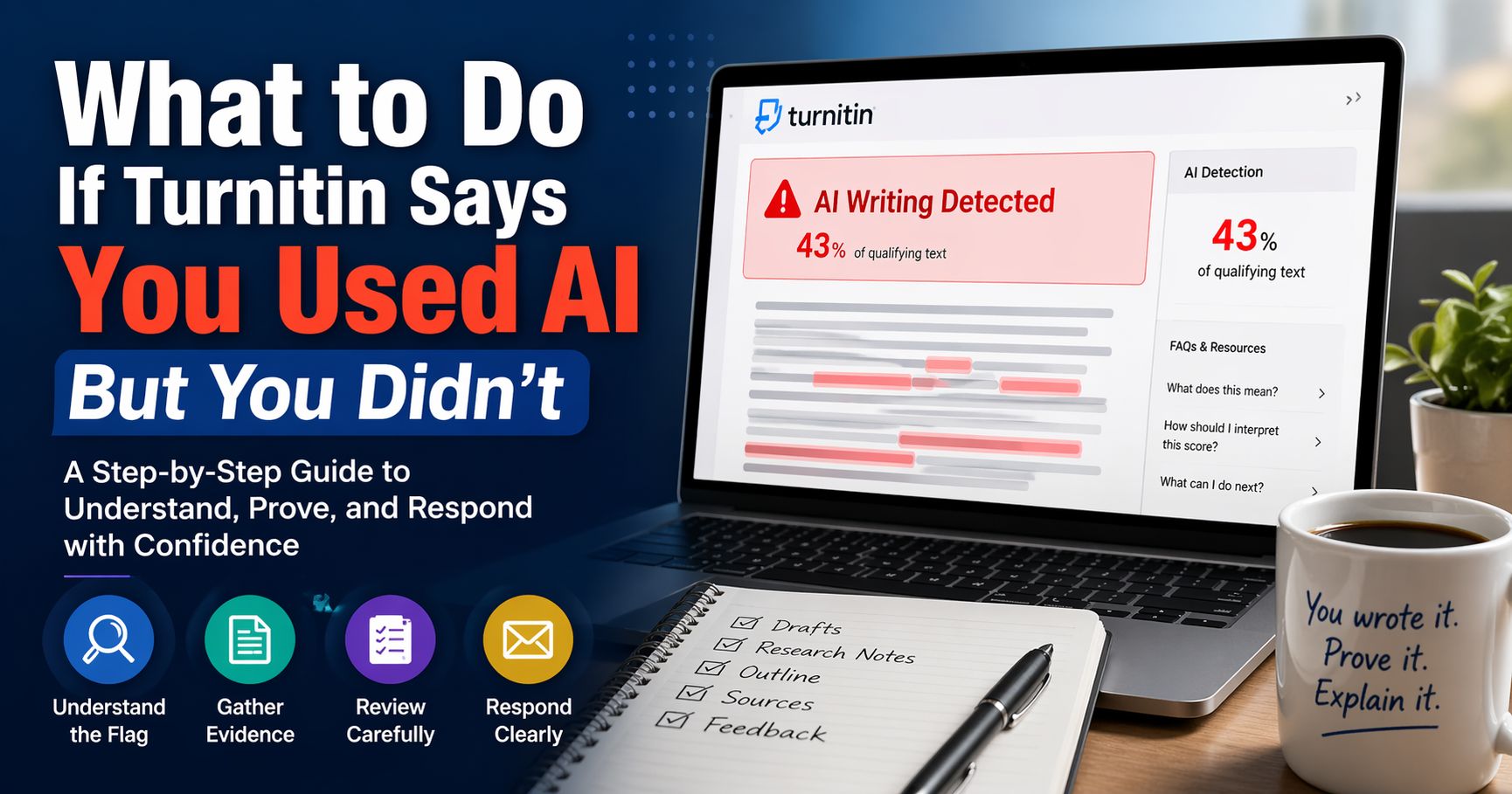
What to Do If Turnitin Says You Used AI But You Didn’t
If Turnitin flags your writing as AI, learn how to review the report, gather evidence, and respond calmly and responsibly.
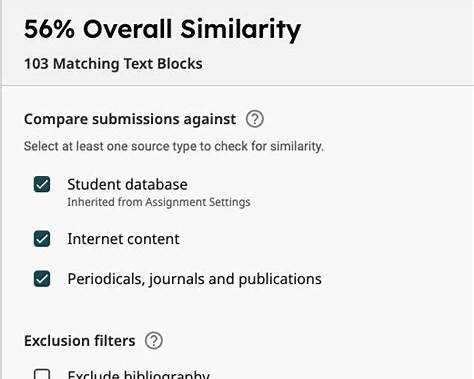
Turnitin AI Accuracy: Why Lab Accuracy Claims Don’t Match Real Classrooms
How reliable is Turnitin’s AI detection in real academic settings? This guide examines accuracy claims, false positives, false negatives, and why AI detection scores should be interpreted as probabilities, not proof.
Can Turnitin Detect ChatGPT? What Students Usually Get Wrong (2026 Guide)
Curious if Turnitin detects ChatGPT content in your paper? This guide explains what Turnitin really measures, common misconceptions from student experiences, real-world false positive stories, and how to interpret AI detection results responsibly.