Turnitin AI Accuracy: Why Lab Accuracy Claims Don’t Match Real Classrooms
Today, the question I hear the most isn’t “Does Turnitin catch AI?” It’s one that’s a little more uncomfortable:
“But is it actually accurate?”
That question generally comes up after a student has found an AI percentage on work they believe they didn’t produce with AI or after an instructor has told them that Turnitin’s AI detector is “very reliable.” At this moment, students aren’t thinking about models or probabilities. They’re thinking about consequences.
I’ve read a lot of Turnitin AI and similarity reports with students and educators over the past few years. I’ve also spent more time reading institutional guidance, research discussions and community debates. What I’ve learned so far is that Turnitin’s AI detection is not useless and not entirely reliable. In fact, it is useful, but it depends on context, writing style and more importantly the way you interpret the score.
This article isn’t about defending or attacking the tool. It’s about answering the question honestly: how accurate is Turnitin’s AI detection out in the real academic settings?
Accuracy Claims vs. Real Classrooms
Turnitin frequently cites accuracy claims to promote its AI detection abilities. These accuracy rates come from controlled test conditions, in which clearly human-written samples are matched against clearly AI-generated samples.
Classrooms aren’t controlled environments.
Students write in divergent ways in real academic settings. Students are native speakers or not. Some write in a rigid structure because that is what they were taught. Some combine AI and heavy revisions. Assignments can range from reflective essays to lab reports to brief analytical responses.
A detector that has only been trained on clean, isolated samples reacts very differently when confronted with blended, revised real-world student writing. That’s why I always pause when someone mentions a single accuracy percent without qualifying the conditions under which it was measured.
A Lab-Test Accuracy Rate Isn’t the Same as a Classroom Accuracy Rate.
Turnitin False Positives: Why Human-Written Essays Get Flagged
One of the most frequent situations I see is a student emphatically insisting, “I wrote this myself.” I think, in many of these situations, they’re telling the truth.
Essays that get flagged often seem to have the same characteristics: paragraph lengths are about the same, arguments are clearly structured, sentence rhythms are predictable, and the language is formal academic prose. Ironically, students are encouraged to write like that.
According to wikipedia, many AI detection tools have accuracy limitations and can misclassify texts.
Statistically, this regularity can look a lot like large-language-model output. AI detectors aren’t assessing intent or author. They’re assessing patterns. So when the writing is very regular, very polished, and very controlled the model will see a machine.
The issue seems to crop up especially often with people who are not native English speakers. They tend to use textbook sentence constructions with precise but repetitive phrasing. Their writing is grammatically correct but stylistically constrained. For a model trained to detect statistical variance, that constraint can look like a machine.
The experience of students in these situations is not, for the most part, guilt. They’re not gloating. They’re being flagged for being too careful.
How Professors Actually Interpret Turnitin AI Detection Scores
Students often think an AI number should always mean punishment. In reality, most professors I’ve spoken to don’t see it that way.
AI numbers are usually just triggers. “Oh look, this part was highlighted,” the teacher might say, or they’ll compare this submission with previous ones, or ask the student to explain their thinking. A sudden change of voice or skill level is usually more concerning than the number per se.
On the other hand, if a student’s a good writer, they may have a moderate AI score on a perfectly acceptable piece. Context, history, and academic sense usually trump the number.
This is a critical gap: the student thinks that’s a verdict, and the professor often thinks of it as one piece of evidence.
Why False Positives Are the Biggest Problem with Turnitin AI Detection
False negatives happen, AI writing can adapt to alter its style, but false positives are the real problem today. They threaten fairness, and they threaten trust.
False positives tend to happen when there is a lot of regularity in writing. Consistently sized sentences, consistent structure, consistently clustered logic are all statistically easier to flag. But those are also qualities of well-disciplined academic writing.
And that means we get to that uncomfortable truth: AI detectors are not detecting AI use, they are detecting statistical regularity. That is not the same thing.
And when statistical regularity is also good academic writing, misclassification is a no-brainer.
False Negatives: The Flip Side
Fair point, AI detection has some holes in the other direction. AI content is likely to be undetected when it has been heavily edited, spuriously mixed with original content, or produced in pieces instead of a single essay.
This paradox is maddening for students and teachers alike. A low score is probabilistic that no AI was used, and a high score is probabilistic that AI was used. The tool is probabilistic in both directions.
The Core Technical Limit of Turnitin AI Detection (And Why It Can’t Be Perfect)
There’s a basic limitation that will stay with any detector: Turnitin has no way to access ChatGPT logs or a central registry of AI-generated text. It can’t track authorship. It can only speculate on style.
Generating models get better, output becomes more varied and more humanlike. And academic writing instruction pushes students toward clarity, structure and consistency. We’re converging.
I’ve read many scholars who believe that no matter how good we get at open-ended writing, we can’t ever reach essentially perfect AI authorship detection in principle. That doesn’t mean detection is futile, but it does limit what it can claim.
So… Is Turnitin AI Detection Accurate?
The most honest answer is conditional.
It tends to be more informative when large sections of text are directly generated by AI with minimal revision. It becomes less reliable when writing is mixed, revised, or stylistically consistent due to academic norms rather than automation.
Instead of asking whether it is “accurate,” I prefer to ask when it is informative. That shift reframes the conversation in a much more realistic way.
In practice, this is why many students choose to review their similarity and AI risk before submission, so they can understand what a report might show and fix obvious issues calmly, rather than reacting under pressure after submission.
If you want to see how a Turnitin-style report looks in advance, you can run a private pre-submission check on the homepage to review similarity and AI indicators without storing your paper in any academic repository.
What Students Need to Remember
I get asked by students what to do with an AI detection score. When they ask me, I have a trick answer. Don’t buy into the score as a verdict. Don’t assume that 0% means you’re exempt. Keep drafts and notes. Be prepared to explain how you did the assignment.
In most challenges, the proof of process is more valuable than the proof by algorithmic inference.
Conclusion: Turnitin AI Detection Is a Risk Signal, Not Proof
Turnitin's AI detection is a fact, not a myth, and it is not a lie detector. It is a probabilistic system that estimates the stylistic similarity to generative AI writing.
It can be useful in few cases. It can also be wrong. It is not designed to definitively answer questions about intent or authorship.
If there is one sentence that most succinctly describes it, it is this:
Turnitin's AI detection is a risk signal, not a validity detector.
Once that is understood, the fear of the number often dissipates and the number takes on a more reasonable interpretation of what it actually means.
FAQ — Turnitin AI Detection Accuracy & Scores
Q: Can Turnitin’s AI detection reliably prove AI use?
A: No. Turnitin’s AI detector estimates how much of a text resembles AI-generated patterns statistically, but this is not definitive proof that a specific tool was used or that the writing is dishonest. It provides a probability signal, not an absolute verdict.
Q: Why do some human-written essays get flagged as likely AI?
A: AI detectors, including Turnitin’s, rely on statistical patterns in writing. Consistent academic structure or formal expression can resemble machine-like text, leading to false positives where human writing is incorrectly classified as AI-like.
Q: Are there studies showing AI detectors aren’t fully accurate?
A: Yes. Independent analysis of AI detection tools finds that many detectors are neither completely accurate nor reliable, and they can produce both false positives and false negatives, especially when texts are paraphrased or mixed with human content.
Q: If Turnitin claims to be 98% accurate, why should I still worry?
A: Claimed accuracy figures often come from controlled testing. In real world use, detectors may perform differently, and higher incidence of false positives or negatives has been observed, especially in nuanced or blended writing contexts.
Q: Should a teacher rely only on Turnitin AI percentages to judge misconduct?
A: No. Educators typically treat AI detection scores as one piece of information and consider writing history, drafts, and other evidence before making academic integrity decisions.
Q: Does a high AI percentage always mean the work was written by AI?
A: Not always. A high percentage suggests stronger resemblance to known AI writing patterns, but it does not prove authorship by AI or intent to cheat. Context and instructor judgment remain important.

Related Articles
View all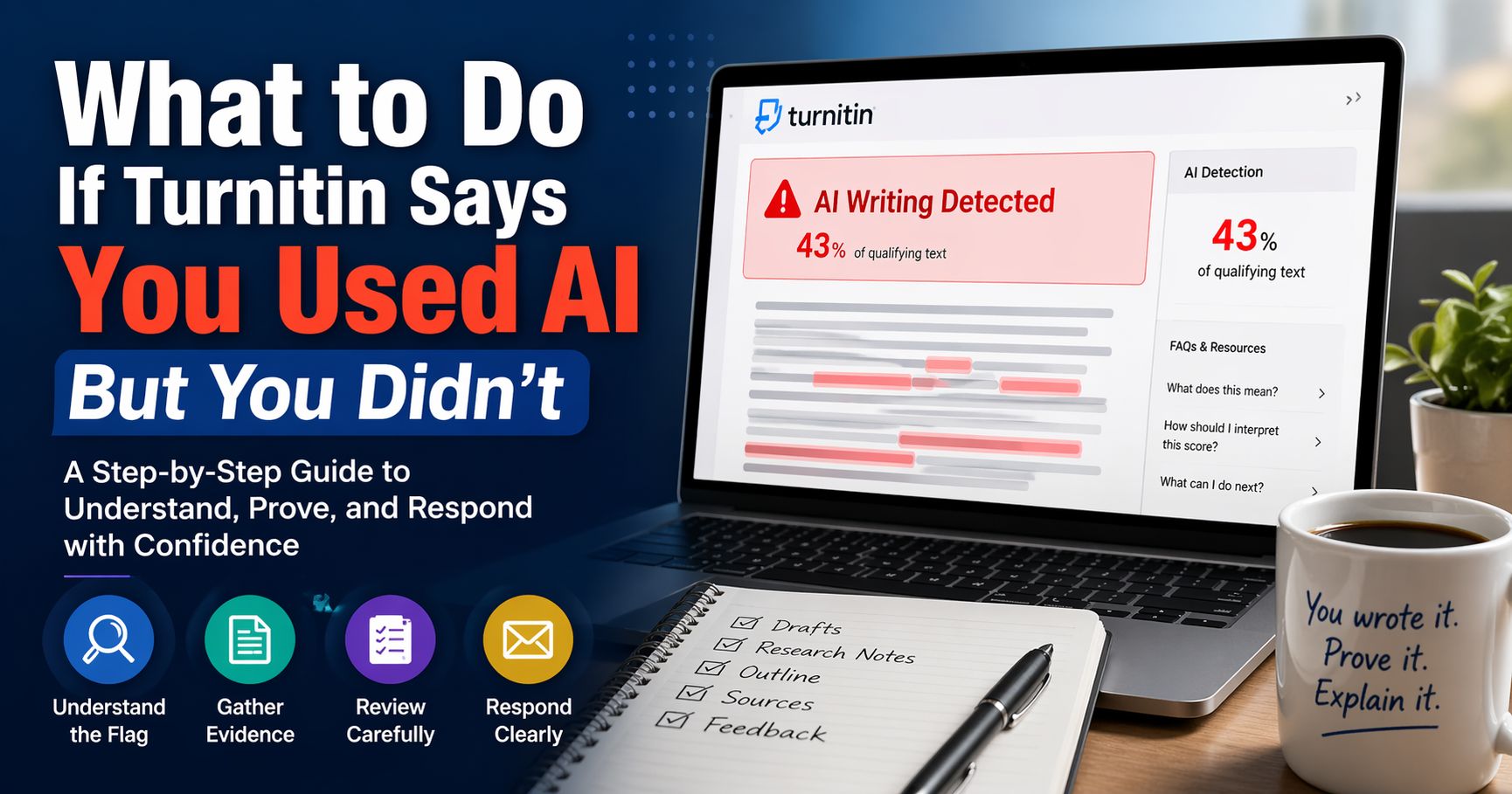
What to Do If Turnitin Says You Used AI But You Didn’t
If Turnitin flags your writing as AI, learn how to review the report, gather evidence, and respond calmly and responsibly.
Can Turnitin Detect ChatGPT? What Students Usually Get Wrong (2026 Guide)
Curious if Turnitin detects ChatGPT content in your paper? This guide explains what Turnitin really measures, common misconceptions from student experiences, real-world false positive stories, and how to interpret AI detection results responsibly.
Why Does Turnitin Flag Writing I Typed Myself? Common Triggers
Wondering why Turnitin flagged your own writing as AI or problematic? This guide breaks down the most common triggers — from statistical writing patterns and phrasing issues to formatting quirks — and explains why even original text can be misclassified.