Does Turnitin Detect AI in 2026? What It Flags, Why It Flags, and Limitations
When I got a Turnitin AI detection score for one of my own assignments, I’ll be honest, I freaked out. I had written my essay, added in all the citations, and not used generative tools. And there it was: a percentage, marked with “AI likelihood”, staring right back at me. I wondered if I’d make some mistake I didn’t know about.
Over the past few years, I’ve reviewed dozens of Turnitin similarity and AI reports with students and instructors, which is why this topic keeps coming up.
I can imagine many people, myself included, were confused about what it meant. I know many students and faculty are under the impression that Turnitin's AI detection simply reports whether you used ChatGPT or some other generative tool. But the truth is more complex than that. So in 2026, Turnitin can report a pattern that is statistically associated with that tool, but it isn't a verdict and certainly isn't gnawing 100% accurate. You have to understand what it’s signalling, what it flags, and most importantly, what it doesn't prove.
If you want a pre-submission check of how your writing might score on an AI detector similar to Turnitin’s before you submit your work, you can use tools like TurnitinDetector.ai to get a quick similarity and AI writing report.
This post will explain how Turnitin's AI detection works, why it can give false positives and false negatives, some real-world cases that caused controversy, and how you should and should not interpret and react to these scores.
1. What Turnitin’s AI Detection Is,And Isn’t
Turnitin didn’t develop its that software to detect AI writing , it was designed to identify similarities with other texts. However, as generative AI tools such as ChatGPT become more prevalent in education, the software company added an AI detection feature to provide teachers with more information on a writing’s possible origins.
So what is Turnitin’s AI detection?
● It’s a statistical model trained to recognize linguistic and stylistic patterns that are more common in AI-generated text than human writing.
● It provides a probability estimate — not an absolute determination — about whether parts of a document look like they could have been generated by AI.
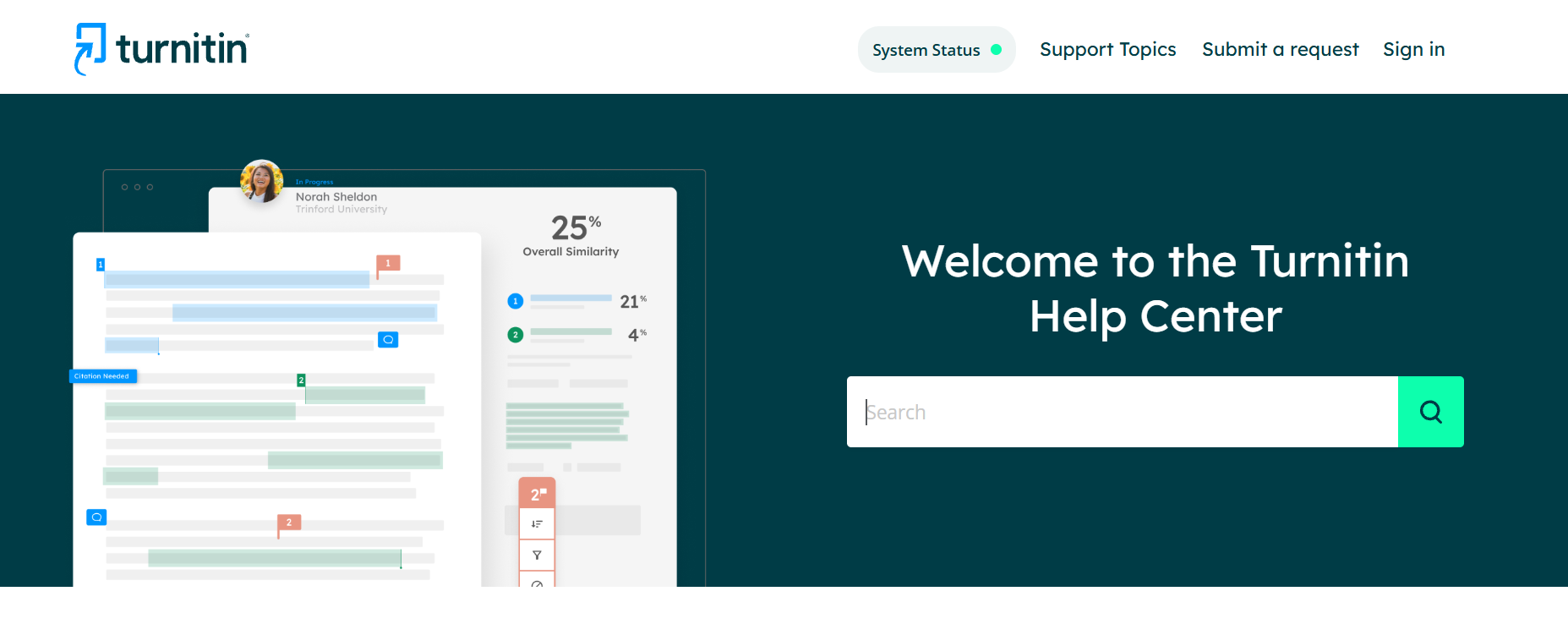
● The AI detection score is shown alongside other integrity results, such as similarity, in the instructor’s dashboard.
What it doesn’t do:
● It does not tell you which specific tool (e.g., ChatGPT, Claude, etc.) was used.
● It does not provide airtight proof of academic dishonesty — it simply flags patterns.
Understanding this distinction is key to interpreting results reasonably.
Turnitin’s own documentation emphasizes that its AI writing detector provides a probability estimate rather than a definitive determination of AI use, and it is intended to support educator judgment rather than serve as conclusive evidence.
2. How Turnitin’s AI Detection Works
Very broadly, AI detection in Turnitin works by chopping a text up into smaller segments and, for each segment, assigning a score based on how it matches patterns that are relatively typical of large language model text, which include:
● Predictability and uniformity of sentences
● Repetitive or very consistent tone
● Lack of irregular human-like phrasing or errors
● Structures resembling statistical properties of machine-generated text
Each segment is then compared to Turnitin’s internal model, which was trained on a blend of human and AI-generated text, and an overall estimate of how much of the text might be influenced by AI is derived.
And here's the nuance:
Turnitin (and the like) don't have any access to the ChatGPT logs and can't match against text you know came from different source. Instead they match against the "style", so it's more like a medical test telling you likelihood, not a forensic verdict.
According to Turnitin’s user guide, when the AI likelihood score falls between about 1% and 19%, an asterisk (*) is shown to signal reduced confidence in the model’s estimate, underscoring that the indicator is not intended as a forensic verdict alone.
3. AI Detection vs Plagiarism Detection
A lot of students mix up similarity detection (traditional Turnitin) with AI detection (newer feature). They’re related but distinct:
● Similarity/Originality Check: Compares your text to a huge database of published works, web content, and other student submissions.
● AI Detection: Evaluates writing patterns rather than checking for matches, it doesn’t care whether the text matched a source, just whether it “looks like” something a model might produce.
Even excellent human writing can sometimes resemble machine style — especially polished academic language. That’s important to keep in mind as we dig into errors and limitations.
4. Accuracy, False Positives, and False Negatives
Turnitin claims its AI detection model is very accurate, often quoting performance figures of 98% confidence level and less than 1% false positive rate under some conditions. These figures come from controlled evaluations, not from diverse classroom settings, which is why Turnitin also acknowledges the possibility of false positives in practice.
But real-world evaluations show a more complicated picture:
False Positives (Human Writing Flagged as AI)
These occur when Turnitin incorrectly tags genuinely human written text as likely AI. This happens because:
● Polished or consistent writing resembles statistical patterns of machine output
● Repetitive academic phrasing
● Certain writing styles from non-native English speakers or neurodivergent authors can trigger flags even without any AI use
In other words, AI detection often flags consistency, not dishonesty.
Turnitin itself acknowledges that false positives are possible and can be more frequent when AI presence is under around 20%, which is why in that range it just shows an asterisk (*) rather than a full percentage, to signal lower confidence.
Broader discussions around AI content detection highlight ongoing challenges with accuracy and bias in such tools, noting that both false positives and false negatives can occur across different systems.
5. False Negatives (AI Writing Not Detected)
No detector is perfect. Some models are no good at detecting paraphrased AI-generated content , meaning that if AI-generated content is heavily paraphrased, the model will see it as “human”. Independent research on detection tools in general suggests many fall flat on the paradox of paraphrasing and can be quite easy to beat.
So just because a detector doesn't flag a document doesn't mean AI wasn't used and just because it does mean AI undoubtedly was used.
6. Real Cases and Controversies
One of the biggest stories in 2025 that resurfaced in academic discussions was the so-called “robo-cheating” scandal at Australian Catholic University (ACU). Many students reported being falsely accused of using AI by Turnitin’s AI indicator, leading to lengthy investigations that delayed graduations and caused emotional distress. Ultimately, ACU discontinued use of that AI indicator due to concerns about reliability, transparency, and false accusations.
For example, in 2024 a major Australian university was reported to have wrongly accused thousands of students of academic misconduct by relying on AI detection tools like Turnitin’s, causing significant scrutiny over the fairness and reliability of the technology.
That incident isn’t unique in community discussions. Educators and students in online forums talk about:
● Flags on human writing leading to academic misconduct reviews
● Confusion about whether an AI percentage counts as proof
● Pressure on students to “prove” how they wrote sections of text
One Reddit user shared how their essay was marked as likely AI by a detector and it jeopardized their core academic requirements — showing how serious these flags can feel in real contexts.
This case illustrates why institutions, not just students, are still experimenting with how — or whether, to use AI indicators responsibly.
7. How Educators Apply AI Detection in Real Life
In what’s spoken for by educators across conversations, they rarely base integrity decisions solely on AI detection. What educators who have discussed this online and in private communities generally agree on is:
● Treat AI detection as one data point, not a verdict
● Combine with instructor insight, writing samples, revision history, or oral defenses
● Use scores to open discussions with students, not to automatically punish them
Since false positives can happen, many institutions require human judgment, some with policies mandating instructor review before any disciplinary process, and a number have halted use of Turnitin’s AI detection feature entirely.
Which is consistent with the recognition that these tools aren’t perfect and context does matter in academia.
Quick rule of thumb: A score starts a conversation; it never ends one.
8. Interpreting Turnitin’s AI Detection Scores
If you see an AI detection score in Turnitin:
Don’t panic at a percentage
A high number doesn’t mean proof of cheating. It means the model has spotted patterns statistically similar to AI, but patterns alone aren’t evidence.
Look at specific highlighted segments
Context matters much more than a raw number. If only a few sentences are flagged, that’s very different from entire paragraphs.
Discuss with your instructor
Many instructors explicitly tell students not to worry immediately about AI scores — instead, they use them to guide conversations.
Use detection scores to reflect on your writing
If you consistently get high AI likelihood with your own writing, it may simply mean your style is highly polished, consistent, or formal — traits sometimes associated with machine-generated text.
9. The Bigger Picture: AI Detectors and Academic Integrity
The takeaway from all of this can be summed up with one sentence: AI detection tools are imperfect models of a difficult statistical question, and none of them are good enough to distinguish human creativity from statistical generative patterns. Even the most advanced tools will struggle when human writing is similar to advanced AI style or if text is well paraphrased.
Educators and researchers are in general agreement that just because there's a tool to do X, one should never assume that X is always true. Many call for:
● Designing assignments that are inherently harder to complete with generative AI alone
● Focusing on critical thinking, reflection, and process documentation
● Using detectors as conversation starters rather than determinants
Universities, too, are increasingly embarking on the same experimental journey. Whether through in-class writing, oral reflection, or providing customized prompts that AI tools can’t easily imitate.
10. Conclusion: AI Detection Is a Tool, Not a Verdict
By 2026 , Turnitin’s AI detection will be able to tell you about Rhetoric , style , but it will never be able to say “this text was AI generated .” It’s a probability model , subject to error , and it needs to be interpreted thoughtfully. False positives and false negatives occur . The best practice is to use detection scores in context , with instructor knowledge and transparent academic policies.
At the end of the day , using AI detection as evidence , not a verdict , is the best way to protect students and academic integrity in a world that is changing rapidly .
Frequently Asked Questions (FAQ) — Turnitin AI Detection in 2026
1. What does the AI detection percentage actually mean?
Turnitin’s AI score is a probability estimate that indicates how much of a submission contains text that statistically resembles AI-generated writing patterns. It does not confirm that AI was definitely used — it signals likelihood based on linguistic cues.
2. Can Turnitin tell which specific AI tool was used?
No — the AI writing indicator does not identify specific tools like ChatGPT, Claude, or others. It only shows a likelihood that parts of the text resemble patterns statistically associated with generative AI.
3. Why does Turnitin sometimes show an asterisk (*) instead of a number?
In Turnitin’s enhanced AI writing report, scores between 1% and 19% may be shown as an asterisk (*). This signals that the model’s confidence is lower in that range, and small amounts of detected AI-like text are not considered reliable indicators on their own.
4. Why might my original writing get flagged as AI?
False positives can happen when the text is very polished, consistent in tone, or follows structured academic language, which can resemble machine patterns. This is especially true for well-written academic prose.
5. Is Turnitin’s AI detection always accurate?
No detector is perfect. While Turnitin reports high accuracy levels in controlled evaluations, real-world results can vary — especially when AI-generated content is paraphrased, blended with human writing, or when human writers use formal, repetitive phrasing.
6. Should instructors take action based only on an AI detection score?
Turnitin itself and many academic policies advise against using AI scores as the sole basis for disciplinary action. Scores are best used as a discussion starter and interpreted in context with writing samples, draft history, or other evidence.
7. Can Turnitin detect paraphrased AI content?
Turnitin’s AI model aims to flag AI patterns even if output is paraphrased or passed through rewriting tools, but such detection is less reliable and may result in false negatives. Heavy paraphrasing reduces the detector’s ability to recognize AI traits.
8. Are similarity and AI detection scores related?
No, similarity checks for matches against known texts and sources, while AI detection analyzes writing style patterns. A low similarity score can still have a high AI likelihood score, and vice versa.
9. What if my Turnitin report says AI detection is unavailable?
AI detection can be unavailable if the file doesn’t meet required formats or if the submission predates the rollout of the AI feature. Instructors may see a message indicating it couldn’t process that submission.
10. Does a high AI detection score prove I cheated?
No. A high score means the text appears statistically similar to AI styles — it is not evidence of academic dishonesty by itself. Human judgment and institutional policy are needed to interpret results fairly.

Related Articles
View all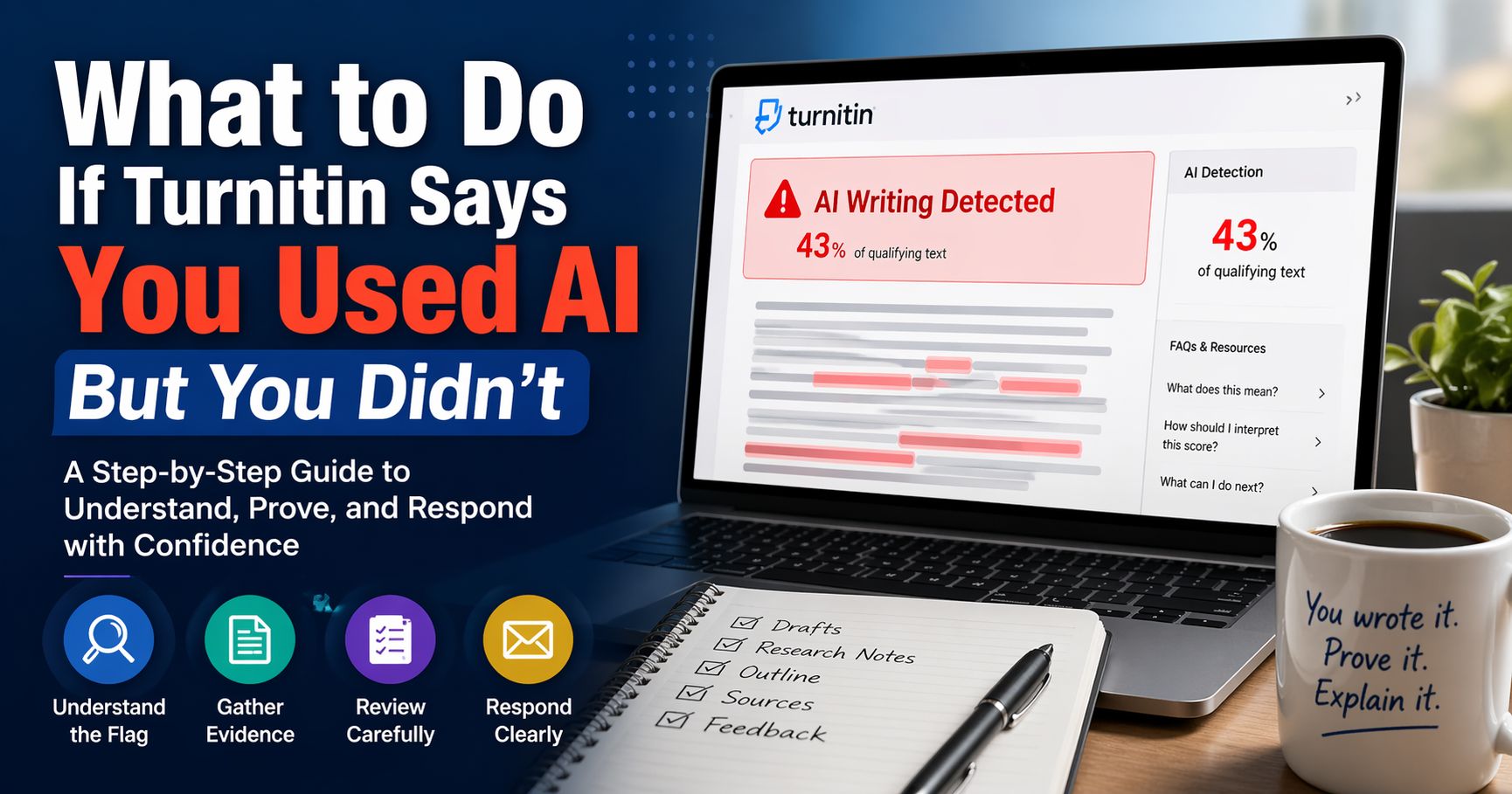
What to Do If Turnitin Says You Used AI But You Didn’t
If Turnitin flags your writing as AI, learn how to review the report, gather evidence, and respond calmly and responsibly.
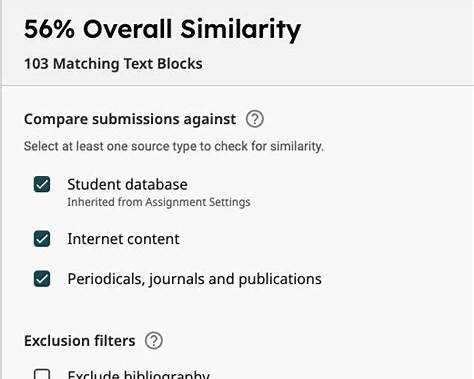
Turnitin AI Accuracy: Why Lab Accuracy Claims Don’t Match Real Classrooms
How reliable is Turnitin’s AI detection in real academic settings? This guide examines accuracy claims, false positives, false negatives, and why AI detection scores should be interpreted as probabilities, not proof.
Can Turnitin Detect ChatGPT? What Students Usually Get Wrong (2026 Guide)
Curious if Turnitin detects ChatGPT content in your paper? This guide explains what Turnitin really measures, common misconceptions from student experiences, real-world false positive stories, and how to interpret AI detection results responsibly.