What Does the % Mean in the Turnitin AI Report? Interpreting AI Scores (2026 Guide)
The first time I saw the asterisk beside an AI number on someone’s Turnitin report, I asked myself, ‘Hmm, what does this even mean?’ This was a friend of mine. He’d written an essay from scratch, but the AI number beside it read *% detected as AI. He asked, “Does this mean Turnitin thinks I used ChatGPT?” The truth is neither of us really knew what the asterisk meant, and it’s a very common student confusion.
In 2026, Turnitin’s approach to AI isn’t simply “AI or not AI.” It produces an estimate of how much of your qualifying text matches patterns associated with generative AI-written text. But when it’s an % rather than a numeric score, it’s actually telling you something particular about the confidence in that estimate. When you understand the meaning of %, and translate that into a real classroom context, you’ll understand what these reports really mean, and how your instructors interpret them.
For a deeper explanation of how Turnitin’s AI detection works, what it can flag, and where its limitations lie, see our detailed guide on how Turnitin interprets AI-generated writing.
1. What the Turnitin AI Percentage Actually Means
Firstly, the AI percentage‑score in a Turnitin AI report is not the same as a plagiarism or similarity score. A Turnitin similarity check will pick up text that matches other texts, but the AI detector looks at writing patterns , the way sentences are put together and how text is flowed , in order to identify what could be text that looks ‘AI‑generated’ .
Think of the AI score as a probability estimate:
● It estimates how much of the text might statistically resemble generative AI patterns.
● It doesn’t check whether it literally came from ChatGPT or any specific tool.
● It doesn’t prove academic misconduct — it’s just data for a teacher to consider.
In real classrooms, instructors combine this score with your writing history, assignment expectations, and other evidence before drawing conclusions.
University library also guides explain that Turnitin’s AI percentage reflects patterns in qualifying prose rather than proof of AI use, and should be interpreted cautiously in academic context.
2. Why Turnitin Uses an Asterisk (*%) Instead of a Number
One of the most confusing parts of the AI report is when Turnitin shows *% instead of something like 5% or 30%. Here’s what that means:
● Turnitin deliberately shows an asterisk for scores between 1% and 19% because detection in that range has lower confidence — and a higher chance of false positives.
● This change was made so instructors and students aren’t misled by small estimates that might just be noise or random stylistic similarities.
In simple terms:
If the AI model thinks something might resemble AI drafting, but it doesn’t feel confident enough, Turnitin won’t show a specific number. Instead, it shows *% to signal “low-confidence AI indicator.”
So when you see an asterisk, it usually means the detected AI-like patterns are very low and not reliable enough to list a precise percentage.
For a deeper explanation of how Turnitin’s AI detection works, what it can flag, and where its limitations lie, see our detailed guide on how Turnitin interprets AI-generated writing.
3. The Difference Between %, 0%, and Numeric Scores
Let’s break down what different AI reports might look like — and what students commonly think they mean versus reality:
📊 *% detected as AI
● Real meaning: The detected AI likelihood is between 1–19%, but Turnitin won’t give a number because it’s too uncertain.
● Common student worry: “This means Turnitin found AI!”
● Real interpretation: This signal is weak and often not meaningful on its own.
👌 0% detected as AI
● Real meaning: Turnitin didn’t detect any notable AI-like writing patterns in the qualifying text.
● Student relief = good, but remember this still doesn’t prove there was no AI use; it just didn’t find strong patterns.
📈 20%+, 30%+, etc.
● Real meaning: A higher percentage suggests Turnitin detected a larger portion of text statistically resembling AI writing patterns.
● How instructors often use this: As a starting point for review, not as evidence.
● Important: There’s no official threshold universally defined as “bad” — interpretation depends on instructor and context.
4. How This Plays Out in Actual Student Cases
Scenario A: You’re Showing *% but Didn’t Use AI
This is the most common situation you’ll see on online threads and in school help forums. Because Turnitin flags low-confidence matches with a asterisk, a paper you wrote entirely yourself could show *% simply because a few phrases statistically looked AI-like.
The student assumes “Turnitin thinks I used ChatGPT,” when it often doesn’t mean that and reflects the system’s caution with low-confidence signs.
Scenario B: Higher Percentage Generates Review
In other cases, the student sees something like 25% or 40%. While not conclusive evidence, the percentage can trigger the instructor to:
● Check out highlighted parts
● Go through draft histories
● Have a conversation with the student about the writing process
A number on the report doesn’t mandate punishment , it just signals investigation, not judgment.
5. Why Even Numeric AI Scores Aren’t Definitive
Even when Turnitin displays a specific percentage, you should know:
● The tool estimates patterns, not source tracking.
● Human writing can occasionally resemble AI patterns (especially formal or repetitive academic prose).
● AI tools are continually changing, and detectors can lag behind.
So a high percentage might be a clue, but not conclusive proof.
Independent research shows that AI content detection tools have inherent limitations, especially when human writing resembles statistical AI patterns or when text is heavily edited.
6. What Students Often Misinterpret
Students sometimes read the AI score like:
● “Asterisk means cheating.”
● “0% = perfect.”
● “Above 20% = automatic penalty.”
None of these are accurate. The asterisk indicates low confidence, and even 0% doesn’t prove anything definitively about tool use. Likewise, a higher percentage should be contextualized, not assumed as wrongdoing.
7. How Instructors Usually Treat AI Percentages
Most educators don’t act on AI percentages alone. They use them as part of a larger picture that includes:
● The writing style compared to prior assignments
● The highlighted portions in the detailed report
● Draft history or writing logs
● Conversations with the student
Turnitin itself notes that this percentage is intended to inform educators, not replace their judgment.
Many universities advise instructors to treat AI indicators as contextual signals rather than standalone evidence of misconduct.
8. Practical Tips If You See an Asterisk or Percent
Here’s how I explain it to students who worry:
● Don’t panic at an asterisk. It often means the detected AI patterns are minor and low-confidence.
● Look at specific highlighted text. That’s where the signals came from.
● Know that context matters. Instructors look at the work’s overall quality and process.
● Keep drafts and outlines. They provide evidence of your writing process if questions arise.
9. Conclusion: What % Really Means
In 2026, Turnitin’s AI report does provide insight into how much text resembles generative patterns, but:
✔ *% indicates low-confidence AI signals and not a definitive match.
✔ Numeric percentages above 20% may warrant review, not conclusions.
✔ These scores are tools for interpretation — not proof of misconduct.At the end of the day, the percentage is a probability signal, not a verdict. Context, discussion with an instructor, and your own writing history are always needed to understand what it means for your work.
FAQ — What the % Means in the Turnitin AI Report
1. What does the AI percentage in a Turnitin report actually mean?
The AI percentage shows how much of the qualifying text in your document Turnitin’s AI writing detection model estimates might be generated by or influenced by AI-style writing. It isn’t a definitive verdict on cheating — it’s a probability-based estimate of pattern similarity.
2. Why does Turnitin sometimes show *% instead of a number?
Turnitin displays an asterisk when the AI detection score falls between 1% and 19%. This range is considered low-confidence and more prone to false positives, so Turnitin hides the exact number to prevent misinterpretation.
3. Does *% mean I definitely used AI?
No. An *% score does not prove that you used AI. It simply means the AI detector saw small signals that could resemble AI writing patterns, but not confidently enough to show an exact percent. Many students see this even for their own original writing.
4. What does it mean if Turnitin shows 0%?
A 0% in the AI report means Turnitin didn’t detect any significant AI-like patterns in the qualifying text. However, even 0% doesn’t prove no AI was used — it just means the model didn’t find enough evidence to suggest AI involvement.
5. When does Turnitin show a full numeric AI percentage?
Turnitin shows a specific percentage (like 20% or higher) when the AI detection model is confident enough that a larger portion of the text resembles AI writing patterns. That doesn’t automatically indicate misconduct, but it often prompts closer review.
6. Is a higher AI percentage automatically “bad”?
Not necessarily. While a higher percentage suggests more AI-like patterns, educators usually interpret it in context — looking at which parts are flagged, how complex the task was, and the student’s writing history.
7. Why might Turnitin misinterpret text even if I didn’t use AI?
Turnitin analyzes writing style patterns, not actual source matches. Highly consistent sentence structure, repetitive phrasing, or very formal academic language — even if entirely original — can sometimes resemble AI-like patterns and be flagged.
8. Does this percentage reflect the whole document?
No — the AI percentage only covers qualifying text, meaning long-form prose in your submission (e.g., essays, paragraphs). Lists, tables, and other non-standard text types generally aren’t included in the score.
9. Should I worry if my report shows % or a low score?
Low scores or an asterisk usually aren’t cause for concern by themselves. Many instructors treat these as low-confidence indicators that don’t imply wrongdoing — especially if you wrote the work yourself.
10. How should I respond if a teacher asks about my AI score?
Be ready to:
● Explain your writing process
● Share drafts or notes
● Discuss why specific sections might have looked formulaic
Turnitin’s AI scores are often one part of interpretation, not the sole proof of misconduct.

Related Articles
View all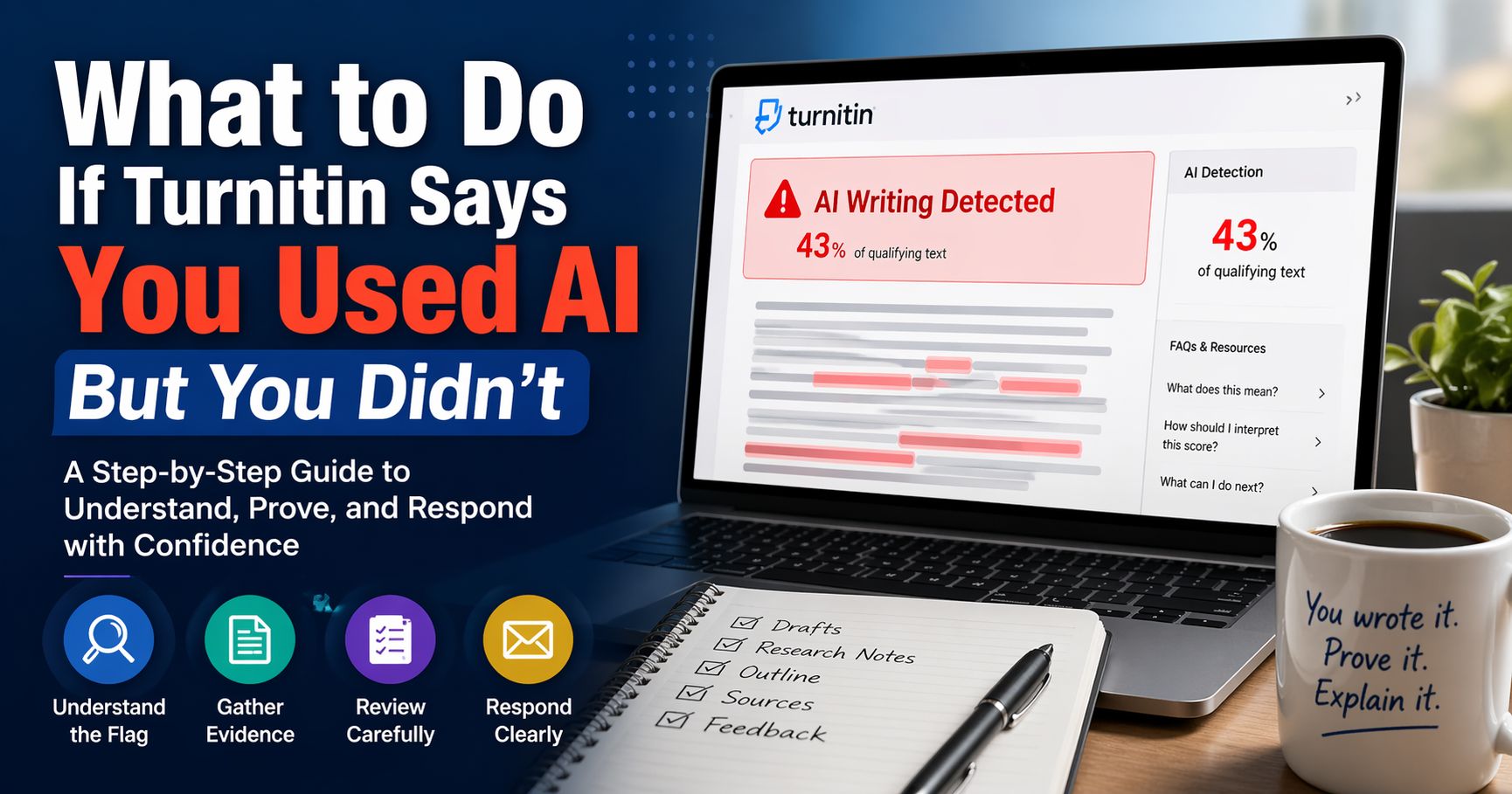
What to Do If Turnitin Says You Used AI But You Didn’t
If Turnitin flags your writing as AI, learn how to review the report, gather evidence, and respond calmly and responsibly.
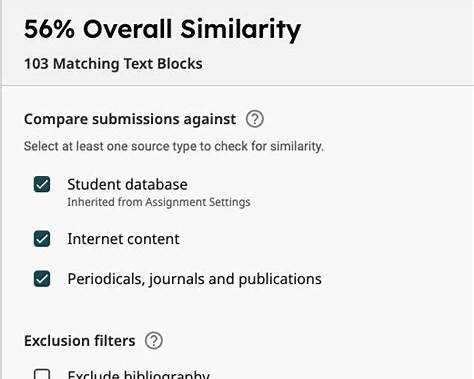
Turnitin AI Accuracy: Why Lab Accuracy Claims Don’t Match Real Classrooms
How reliable is Turnitin’s AI detection in real academic settings? This guide examines accuracy claims, false positives, false negatives, and why AI detection scores should be interpreted as probabilities, not proof.
Can Turnitin Detect ChatGPT? What Students Usually Get Wrong (2026 Guide)
Curious if Turnitin detects ChatGPT content in your paper? This guide explains what Turnitin really measures, common misconceptions from student experiences, real-world false positive stories, and how to interpret AI detection results responsibly.