Turnitin Similarity Score Explained (2026): What It Really Means & How Instructors Interpret It
Summary
Key Takeaways
●Properly cited and quoted text can increase the score.
●Different levels of matching require detailed review, not numeric judgment alone.
●Instructors use the report details to interpret academic context, not just the percentage.
●Understanding your similarity report empowers you to improve your writing and citation practices.
When I first encountered the percentage displayed on Turnitin's similarity report, I knew it was a judge of plagiarism and a number that was, in effect, my grade. But over time, I've come to realize that the similarity percentage is more complicated. It indicates the degree to which I might be copying from other works, but on its own it doesn't indicate academic dishonesty. Rather, the number is a tool, one element in an instructor's larger process of gauging how I've used sources in my writing.
In this post, I'll explain what the similarity percentage means, how it's calculated, how to interpret ranges, how to read the underlying report, and what I do afterwards when analyzing a score.
See Turnitin's full artivle to understand the similarity score.
1. What Is the Turnitin Similarity Score?
Put simply, the similarity score is:
The percentage of your submission that matches text from Turnitin’s extensive database.
Turnitin compares your paper to billions of pages of internet content, academic journals, publications, and other student submissions. The software then calculates what proportion of your writing overlaps with that database. If the text in your work is found identically or with high similarity elsewhere, it contributes to the score. Visit the similarity score guidance for students.
It is important to understand:
● This score does not classify your work as plagiarized. It purely reflects text similarity.
● Even properly cited quoted text and reference lists will generally show up as matches.
2. How the Score Is Calculated
Turnitin calculates the similarity score by dividing the number of matched words by the total number of words in your submission:
Similarity Score = (Matched Words / Total Words) × 100%
For example, if 150 words in a 1,000-word paper appear in Turnitin’s database, your similarity score would be 15%. This doesn’t inherently mean that there’s a problem, it just shows how much of your text overlaps with known sources.
3. Color & Percentage Interpretation at a Glance
Turnitin uses a color as well as a similarity score to give you an immediate visual snapshot of how much matching text was identified. These ranges are based on the amount of matching text, not on academic judgment:
Color | Similarity Range | What It Suggests (Quick Guide) |
🔵 Blue | 0% | No matching text found — fully unique according to current database |
🟢 Green | 1–24% | Low level of matches — often typical for well-written papers |
🟡 Yellow | 25–49% | Moderate matching — review the matched sections for proper citation |
🟠 Orange | 50–74% | High matching — examine closely for potential improper attribution |
🔴 Red | 75–100% | Very high matching — likely indicates large blocks of overlapping text |
💡 Color schemes may vary slightly depending on how your institution implements Turnitin, but these general ranges are standard in most settings.
4. Similarity ≠ Plagiarism — A Critical Distinction
A high similarity score does not automatically mean plagiarism, and a low score does not guarantee academic integrity. Here’s why:
✔ Legitimate Matches
It’s normal to see matches from:
● Quoted text, even with proper citations
● Reference lists and bibliography text
● Common discipline-specific terms and phrases
These kinds of matches will increase the similarity score but are perfectly acceptable when properly used.
✔ Non-Problematic Matches
For example:
● Your professor’s assignment instructions (if included verbatim)
● Standard definitions or universally accepted terminology
● Your own previously submitted work (depending on settings)
Any of these can contribute to the score, even if you didn’t intend to copy others.
✔ Matches That May Have Academic Concerns
Some matches may indicate a need for deeper review:
● Blocks of text that appear without necessary quotations or citations
● Copying phrases longer than a sentence from a single source
● Repeating another student’s original work
However, even here, context is key — the similarity score should prompt a review, not a conclusion.
5. What Instructors Actually Do With the Score
Instructors do not take the similarity score as a conclusion , , but rather as a starting point . They usually:
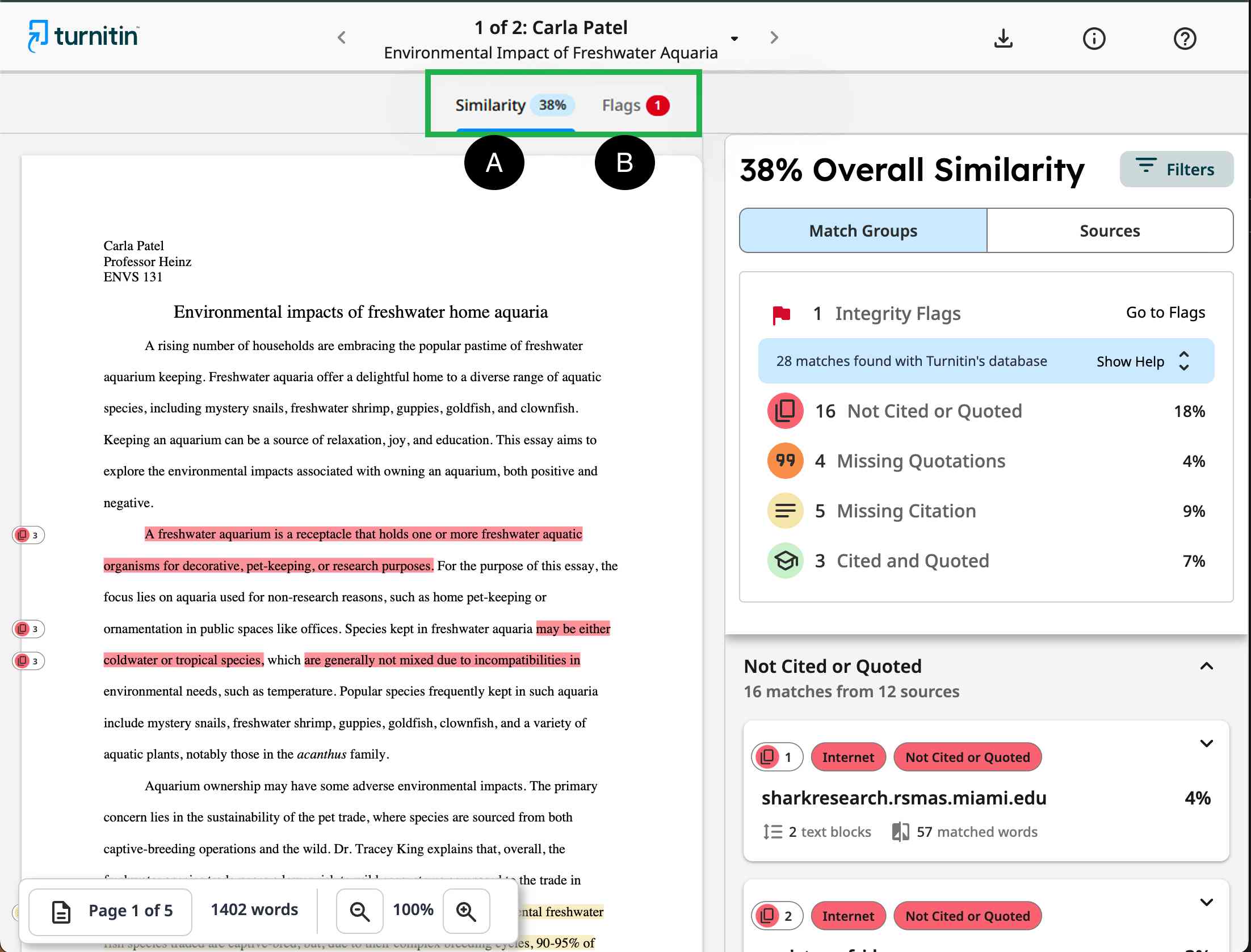
1. Open the Similarity Report in detail, which shows the sources that match and also displays the specific matched text for each source.
2. Look at each matching passage to determine if it is properly cited and quoted.
3. Determine if the matching text is appropriate in the context of the assignment.
4. Use the Filters to remove reference lists, quotation marks, or small matches to gain an actual picture of the overlap.
Instructors can in fact be completely indifferent to a numeric threshold , focusing instead on why the text has matched and whether the student is exhibiting good academic practices in doing so.
6. How to Read the Detailed Similarity Report
After submitting your paper:
1. Click the similarity score to open the full report within Turnitin’s Feedback Studio.
2. Review the “Match Overview.” It lists all sources that have text in common with your submission.
3. Click on each source to see exactly which parts of your text matched and how many words matched.
4. Look at the context. Matches may be flagged from:
a. Publications and websites
b. Previously submitted student papers
c. Other library resources that Turnitin indexes
If matched text is properly quoted and cited, it’s usually fine. If not, then that flag serves as a prompt to revise or clarify your writing.
Visit this article to understand can I run my paper through Turnitin before submitting?
7. What to Do After Seeing Your Score
When I review a similarity score, I follow these steps:
● Don’t panic at the number itself. A 30% score could be mostly correct citations; a 10% score could still hide improper paraphrasing.
● Open the detailed report and examine every match to understand its origin.
● Check citations, quotations, and paraphrasing. Ensure each match is academically appropriate.
● Discuss unclear matches with your instructor rather than guessing at what the number means.
This approach helps me use the similarity score as a learning tool, not a score to fear.
FAQ
1. What exactly does the Turnitin similarity score measure?
The similarity score is the percentage of text in a submission that matches or is similar to text in Turnitin’s database. It does not tell you whether you plagiarized — it just shows overlap.
2. Does a high similarity score automatically mean plagiarism?
No — a high score means there is a lot of matching text, but those matches might come from properly cited quotes, references, or common phrases. The similarity score is a starting point for review, not a plagiarism verdict.
3. Why do citations and reference lists show up in the similarity score?
Turnitin highlights any text that matches its database — including quotations and references — because it compares your document with all stored sources. Correct quoting and citations still count as matches.
4. What do the different color codes in the similarity score mean?
Turnitin uses color coding to represent the amount of matching text found:
🔵 Blue = No matches
🟢 Green = Low matches
🟡 Yellow = Moderate matches
🟠 Orange = High matches
🔴 Red = Very high matches
This color guide is visual and not a judgment of academic misconduct.
5. Are there “acceptable” similarity percentages I should aim for?
There is no universal “acceptable percentage”, because what’s acceptable can vary by assignment type, discipline, and instructor. Students are encouraged to check the details of matches, not just the number.
6. Does a low similarity score mean my writing is safe from plagiarism concerns?
Not necessarily — even a low score doesn’t guarantee academic integrity. A match could be hidden in a short sequence of words, or improper paraphrasing can still raise issues despite a low percentage.
7. Why might a paper have a very high similarity score even if I didn’t copy anything?
This can happen if:
Your assignment includes a lot of quotations
The bibliography is extensive
You used standard terminology that appears in many sources
Turnitin highlights everywhere there’s overlap — so correct academic practices can still raise the score.
8. What do instructors actually do with the similarity score?
Instructors use the score as a tool to guide review. They look at the detailed report of matched text to decide whether citations are correct or whether there are problematic similarities.
9. What if I see matches to other student work or earlier submissions?
Turnitin’s database includes previously submitted papers. Sometimes a high similarity score means your text matches prior drafts or someone else’s paper in the system — which doesn’t automatically mean misconduct but merits careful review.
10. How can I interpret the detailed match results after seeing the score?
Once you open the full similarity report:
View the matched sources list
Click on each match to see where it occurs in your text
Check if it’s properly cited or legitimately similar
Discuss confusing matches with an instructor if needed.
11. Why doesn’t the similarity score appear immediately?
Sometimes it can take time for the report to generate, especially if multiple drafts are submitted — it may show a delay while Turnitin recalculates.
12. Can Turnitin tell me where the matching text comes from?
Yes — the detailed similarity report shows which source each match came from, and how much of the text was similar. This helps interpret whether the overlap is legitimate or not.
13. Should I talk to my instructor if my score seems high or confusing?
Absolutely. If you don’t understand the matches, instructors can explain context and expectations — many times a high score is due to formatting, references, or correct citations rather than misconduct.

Related Articles
View all
Why Turnitin Flags Citations, Quotes & References: What It Really Means
Turnitin often highlights properly cited quotes and reference text,and it doesn’t mean you plagiarized. Learn why citations show up in similarity reports, what “false alarms” are, and how I check and interpret them without breaking formatting.
Is 25% Turnitin Similarity Bad? How to Interpret Matches & What Matters Most
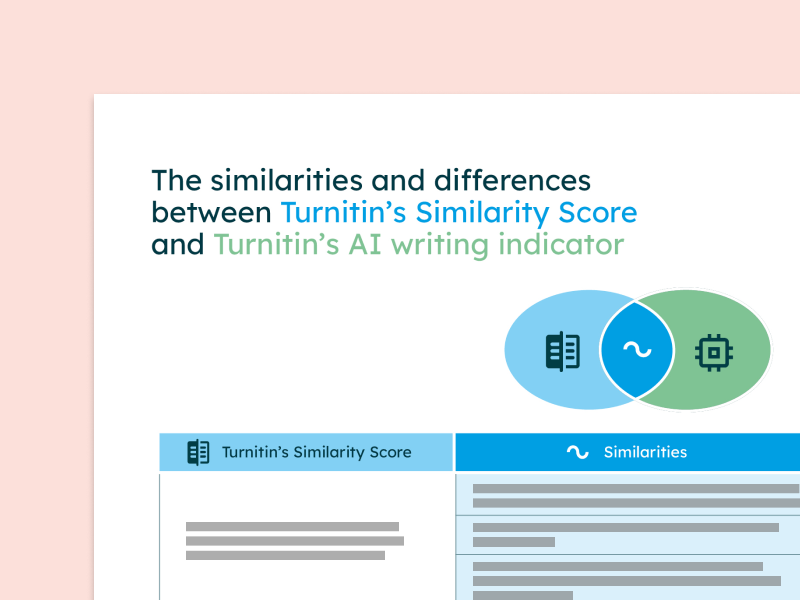
Got a 25% similarity score on Turnitin and feeling worried? This guide breaks down what that percentage actually means, how to examine the matched text, and when a high similarity score is truly a concern, beyond just a number.
What Percentage Is Acceptable on Turnitin? Why Context Matters More Than the Number
There’s no single “acceptable” Turnitin similarity percentage, what matters most is how matches were generated and interpreted. Learn why context matters more than a number, how to read your report, and when to consult your instructor.